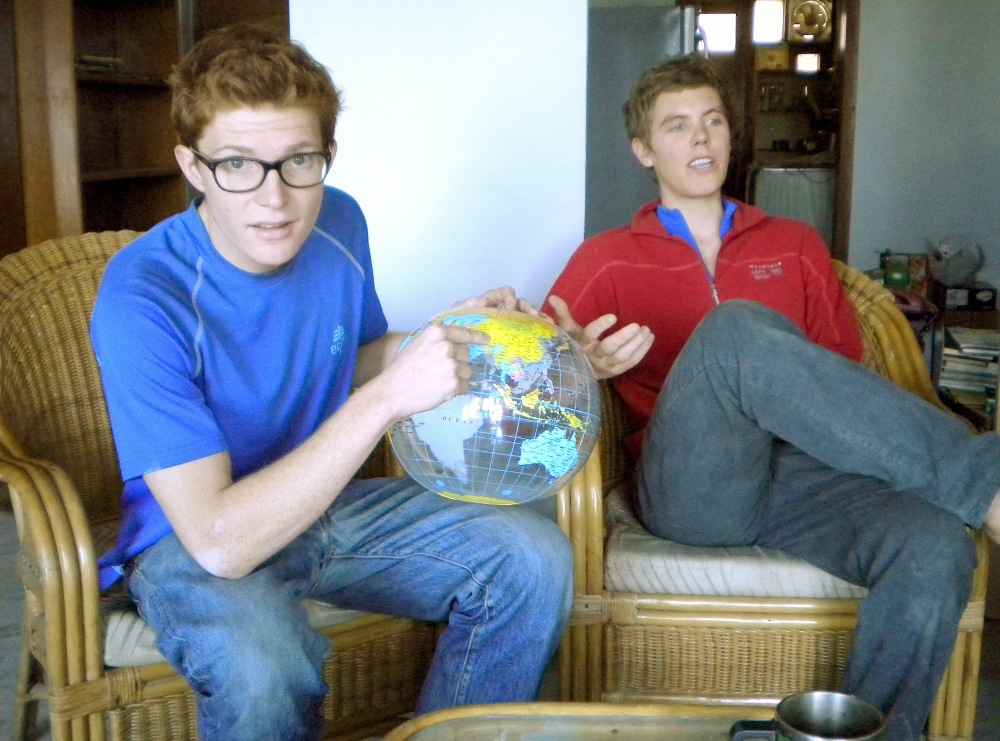
Uncovering Burma: Parts 1 and 2

Author’s Note: We cycled through Burma for five weeks. The following 10 part series is our account of how recent political changes in this historically isolated country are affecting the lives of its everyday citizens. 

Part 1: The Anime Convention

Lone Lone, Pinky, and Russell did not go to the international food expo in Yangon to see the new whirling, non-stick Japanese rice cookers, or the cheddar cheese from the Australian food stand. They came to see the Cosplay Show.

The Cosplay show was hard to miss. Located at the far end of the convention hall, aside from the rows of booths with short-skirted attendants seducing Burmese wallets with their bizarre array of industrial water filters, gourmet pasta sauces, and instant coffee brands (complete with dancing mascots), the cosplay show was the main attraction of the week-long Japanese invasion. “Oh my god, here they come!” we heard a Burmese teenager exclaim.

We followed his eyes to the stage, where three doll-like figurines, dressed head to toe as human interpretations of animated Japanese anime characters, began a choreographed dance to techno music.  They wore 3 foot colored hair extensions, metallic makeup, and prop swords that whirled around the stage with them. The Burmese youth rushed to the edge of the platform and started fist-pumping like they were at a Metallica concert. Others walked over from the rice cookers and stood against the wall with baffled curiosity.

“Dude, that was awesomeeeee!” Lone Lone said afterwards. The long-haired, Burmese rock musician and graphic designer was the reason we were there; he invited us to event after we found him on couchsurfing.org and sent him a hangout request.

“Yeah man — that was bloody awesome” agreed Russell.

Despite the heat, Russell was dressed in zebra-print tights and a shiny leather jacket. He also spoke though a heavy British accent.

“Oh — did you learn your English in the United Kingdom?” we asked him.

“Nope,” he said. “I learned my English from Adele.”

We thought he was joking, but he wasn’t. The Burmese fashionista had acquired his British accent from listening to interviews with top 40 soul singer.

Pinky was the only girl in our group, but she seemed to know the most about the anime characters at the event. She kept running off to grab pictures with characters from her favorite shows. Her bubble gum dimples and dangling earrings matched with the exaggerated ‘peace signs’ she made in her poses.

We all took a “gangnam style” group photo in front of the convention center, and then decided to retreat to the shade of a nearby tea house, where – being only our second day in Myanmar — we were eager to ask our new Burmese friends about all the political changes we had been reading about in Western newspapers. “So what do you think about Thein Sein?” “What will happen with Suu Kyi?”

They looked at each other.

“Um. We don’t really talk about politics.” Lone Lone said.

We were surprised. It certainly didn’t sound like the democratic revolution we were expecting. So what did Lone Lone, Pinky, and Russell mean when they kept referring to the “changes” happening in Myanmar? After we heard them throw the clichéd term out a few more times, we pressed for an answer.

“More cars.”

“ATMS.”

“Faster Internet”

It clicked. At least for this group of 20 years olds in Yangon, “change” wasn’t necessarily new ways of thinking, “change” was opportunity. Change was something new to see, something to get excited about. “Change” meant a series of firsts. The first Cosplay shows. The first film festival. “and the first Jason Mraz concert!”

That change was already affecting how they lived their lives. At the end of our tea, we were surprised to learn that the Burmese had not known each other before the attending the Cosplay show. Just like us, they met at the event.

“That’s what’s so cool about these new events, they’re bringing people together.” Lone Lone said.

As we left, everyone exchanged phone numbers, facebook IDs, and email addresses. Then Lone Lone and his new friends went off to the mall to check out a brand new coffee shop.

Continue reading

Posted in Journalism | Tagged | 2 Comments

Party Island


The backpacker’s circuit in Southeast Asia has is infamous for its debauchery and out of handedness. Whether it’s numbered bartender girls along Soi Cowboy in Bangkok, or flaming jump ropes on Ko Tao island, the possibilities for shenanigans appear endless for the young and impressionable Western traveler. Perhaps nowhere is this more visible than on Don Det, a small booze-soaked island bobbing in the middle of the Mekong River in Southern Laos.

It was a convenient location for us. Morgan and I needed to kill a few days before entering Cambodia because of visa issues, and Don Det was situated right along the border.  We also just wanted to get swept up in the backpacker’s atmosphere.  On Don Det there was no resisting it. We ended up at Smiley Bar the first night, the place that seemed to represent all the glories and suburban mom’s worst nightmares about the SE Asian backpacker’s circuit wrapped up into one.

It was 9pm. “More Lao Lao!” the Frenchman screamed, waving moonshine rice liquor in a plastic bottle wildly around his head so it splashed upon the people around him. The shot glasses that answered his call were poured in a continuous stream that left more liquor on the table than in the glasses. At two dollars a bottle, it wasn’t a big deal. Another crazy-eyed French woman (Smiley’s was the French spot apparently) commandeered the stereo system and changed the song to a furiously tempoed number with slapping bass and cowbell and accordion, and jumped up on top of the bar.

The poor Laotian bartender furiously scribbling down everyone’s swelling bar tabs couldn’t curtail the flood. Everyone started jumping up on the bar. I saw him dive to catch a falling glass, and then another. He was barely keeping the scene together. The bar itself was swaying dangerously on the few wooden stilts supporting it above the tides of the Mekong.

Midway through the song, an eight or nine year old Laotian kid ran into the bar wielding a squirt gun, and let loose on the crowd. “Shit!” “Surprise attack!” someone yelled.

“I’m Hit!” I called out, clutching my shirt to cover mock bullet wounds and jumping off to the side to avoid getting further doused. Another couple dancing nearby dived back towards their table, where they had their own squirt guns on standby, and launched a full counter-offensive. Suppressing fire and two tangos on the kid’s flank!  He was outnumbered. Under a heavy barrage of fire, the bogie retreated from the bar back into the jungle to regroup with his other 8 year old comrades. I’d been witnessing similar scenes all day. Around the Laotian New Year, one of the traditions is soaking family members and friends with water, and squirt guns seem to be an integral part of the operation.

At this point our food still hadn’t arrived. (Note to self: never order food at a Laotian bar). I could feel three beer Laos getting on top of me, and Morgan had started salsa dancing with the girlfriend of the Aussie I was trying to maintain a coherent conversation with. He and I exchanged knowing looks.

Then Elina was calling me over to the bar, to meet someone I suppose. Elina was Don Det’s networker. Every backpacker’s destination has one – the “super” traveler whose unofficial, self-designated duty is to keep track of everyone who comes and goes, determine who needs to meet who, and knows what happening places to be at the right times. She gave us the tip to go to Smiley’s when we met her in a bar earlier that day watching Hot Tub Time Machine.

My problem was I couldn’t approach the bar without getting more shots of lao lao pushed towards me by the Frenchman who looked like a sunburnt raisin. I scanned the room instead for attractive, single females, didn’t see any besides the one passed out and sprawled on the floor in the corner – an early causality – and so I elected to take the middle of the dance floor where the Frenchman couldn’t get to me.

“Heyyy!”

Ohr and Ohr, two Israelis named after the same conjugation, were hailing me from Smiley’s entrance. They were high as a kite, finishing off the last puffs of a joint after god knows how many since I’d met them at Rasta bar earlier that afternoon. The availability of weed on Don Det is something of backpacking legend in Southeast Asia – the menus at many restaurants give you the option to “make it happy,” and the Laotian government has turned its back on the practice because it’s become such a grand tourist attraction.

Ohr and Ohr couldn’t handle Smiley’s. The frenetic energy of the dancing Frenchmen and blaring cowbell was a little too much for them in their state, and after yet another beer Lao, it was becoming a little too much for me as well. I was getting sloppy, and so at 10pm I tapped out.

The next morning I sat at Mama’s café, nursing a massive headache I hoped to solve with some greasy eggs. Ohr and Ohr arrived there soon after me, walking directly into the kitchen to ask Mama for their “usual.” The cook had gotten to know them well in their 5 days on the island. They emerged from the kitchen toting with two glasses filled with a creamy, coffee colored drink.

“I always start my morning with a happy shake” Ohr said to me with a wink.

My god. I thought.

I can handle the debauchery thing for one or two nights, but I can’t imagine doing it every day. Smiley’s and Don Det were perfect for what it was, a brief dip into a different world of travelling. But once I’d gotten it out of my system I was ready for Cambodia. Beyond those next villages and rice fields and small cities and campsites we’ll cycle through, I knew we’d eventually cross paths with the backbacker’s soon enough. When my greasy eggs arrived, I tucked in. I found myself wondering what our next encounter with the SE Asian Backpacker’s trail might bring.

Posted in Travel Adventures | Tagged , , | Leave a comment

The Ultimate Bromance

Most friendships have a time and place that define them. Contexts to give them structure. People tend to compartmentalize their social networks, taking individuals in measured doses. There might be a buddy for beer drinking. A co-worker to gossip with. And a family friend to confide in. Each relationship is unique, a contract between individuals to fill some part of each other’s lives.

Of course, friends enjoyed too long in the wrong context can become distant. Usually, that doesn’t have to happen. Friends can always take a break when nerves start to fray.

The two scrappy young Americans camped on the lawn south of Paris would not be able to have that luxury – a fact they did not fully appreciate. They would be stuck together for two years.

Chris swore under his breath. The problems were already starting. He was fidgeting with a camp stove, and having trouble lighting it.

“Dude. I think we bought the wrong fuel…”

Morgan, who could read French, looked at the label and saw that his partner had purchased rubbing alcohol instead of kerosene. He pointed it out, and breathed in any further comments.

It was their first night of hundreds, and their REI tent marred a landscape that suggested the aristocratic splendors of 18th century Europe—complete with a chateau, lily pad speckled moat, and iron drawbridge. It had been an exhausting first day. They hadn’t cycled nearly as far as they intended, only knocking down 70 kilometers after getting a late start from Paris. It also didn’t help when Morgan got his bike bag strap wound up in his rear wheel axel. Both of them were completely clueless when it came to bicycle touring.

Chris tried the stove again. It refused. He set down the lighter and laughed.

Suddenly, their idea of bicycling 12,000 miles from Paris to Shanghai seemed ridiculously herculean.

As the pair’s hungry eyes drifted towards the uncooked bag of spaghetti, they began to contemplate all the difficulties that lay ahead of them – the unknown cultures, bad weather, broken equipment, buying the wrong fuel…damn. It was overwhelming.

Morgan and Chris had met at the age of 14, during middle school when they ran on the cross country team together. One could say the context of their relationship was adventure. Camping. Backpacking. Rock climbing. Over the years, they became each other’s go-to buddy for short outdoor trips. Even after going off to different colleges, they would link up during breaks in Los Angeles to go trekking in the Sierra Nevadas, or bouldering in Joshua Tree.

On a backpacking trip together in 2009

Adventure was the connection that made embarking on a two year bicycle journey together appealing. From their time on the trails, each knew the other was crazy enough he just might do it. But they also knew they needed specific things from each other.

For Morgan, Chris was a logical thinker, a brutally hard worker, and a logistics guru. He knew he needed someone who could organize and plan, two things he disliked with passion.

For Chris, Morgan was the smooth talker. He was much better at convincing people of his ideas. This ability was critical if they were ever to raise enough money to set out on the journey to begin with. It was Morgan who convinced the chateau owner to let them camp on his lawn.

Six months had been spent planning and fundraising for the trip with these thoughts, and neither had given much consideration to what spending 24 hours a day together on the road really entailed. To live out the journey, they would need to be so much more than a logistics guru, a smooth talker, or an adventurer. They would need to be confidants, accountants, editors, bike cleaners, cooks, and stove lighters. Their friendship could no longer be compartmentalized. Being together all the time meant getting all the bad with the good – insecurities, imbalances, and faults that didn’t reveal themselves beforehand. In the more difficult and stressful moments, small annoyances would snowball into big problems. The whole affair wasn’t unlike a marriage, though they both refused to approach use of the term.

Like a marriage, it had all sorts of pitfalls they’d never dreamed of.

Whoosh!!

Chris finally had the camp stove lit. In the glare of the flames, Morgan’s hungry eyes instantly became more cheerful. Spaghetti was back on the menu, and his partner’s annoying mistake had been resolved. This time at least. They joked as they dug into their dinner.

  Continue reading

Posted in Travel Adventures | Tagged , , , | 7 Comments

The True Cost of a Photograph

Everyone has a camera nowadays.  Even if you don’t want one and never use it, it’s on your smartphone.  If you are travelling, then you at least have a point and shoot. If you’re an avid photographer, then you spent the money on a DSLR, maybe even the thousands of dollars it takes to get a pro-level camera and all the accompanying lenses.

It never fails to amaze me how much people like to use them.  Friends of mine on Facebook are uploading photos daily.  Travelers I meet never seem to have their cameras far from hand, myself included. They cameras are taken out at the slightest provocation: a cute kid, a delicious looking meal, a beautiful view, or just out of boredom, when walking down the street.  Taking photographs is so ubiquitous that some tourist attractions in Burma decided they could make more money charging entry for cameras than people.

But the nervous tic of photography comes at a cost.  It is higher than most appreciate.

First, it kills the moment. It redirects focus from simply enjoyment, reflection, or bonding into focusing on the composition of a photograph.

Perhaps the best example I saw of this was in Bagan, a dry valley with thousands of temples across it that is Myanmar’s premier tourist attraction.  People go there to watch the sunset.  It is a majestic sight to behold.  Best viewed perched on a monument of stone half a millennium old, the sun dies the pagodas pink and the hot air cools, and what with the hundreds of buddhas scattered around you, it give the feeling of peace, or of being on a religious mushroom trip.  It doesn’t sound like silence though, if you go to the popular viewing spots.  It sounds like the click click click click of hundreds of DSLRs and heavy breathing and low muttering as the owners attempt to correct their aperture and exposure, or curse their own cameras in jealousy of the 5D on a tripod next to them.  The sound snaps you out of the peaceful trip fast.

Even in my own family’s vacations, cameras make regular mood-spoiling experiences. Two weeks ago, my family came to visit in Thailand, and we took a one week trip down to Ko Tao, a tropical island in the gulf.  There were five us on the trip, and seven cameras.   We might be hanging out, playing in the water, or taking a ride into town on one of the long boats, when someone would decide to take a picture. It would be fine if it was just a quick shot.  But it never was.  There was always someone who had get out of the shade into the burning sun to squeeze themselves in frame, or who had to take off their sunglasses and find their bag to put them in.  It was inevitable that a conversation was interrupted, maybe even a good one, of two relatives squeezing in some one on one time in the zoo of group travel.  Of course, it was never enough for one person to take the shot, either.  You can share a photo in less than ten seconds, but everybody wants their own.  So the cameras would rotate, at least four of them, until the last shots were squinty eyed from the sun and I’d be cursing myself for not putting more sunscreen on.

The worst part is that, in the hundreds of photos we took during the trip to Ko Tao, and the thousands that were taken every morning and evening of the sun in Bagan, I can’t for the life of me figure out what those photos are for.  OK, so you put a few of them up on facebook for your friends.  But most of them go into some digital catalogue that you won’t look at for a long time, and may eventually disappear when your harddrive fails a few years from now, or you reset your system.   A few you may keep, but not many.  I’m not trying to say that all photos are useless, just positing that the majority of them amount to nothing, and that many moments are killed for photos that are looked at once and forgotten.  The moment might have been far more memorable.  Plus, if you really want a photo of the sunset on Bagan, just google it.  A pro already did it better than you.

The second real cost is that it builds barriers in between you and the subject.  This is especially important in foreign countries where you have to make friends across culture and language barriers.   I once did a story about a man who worked at Galata tower in Istanbul, selling paper birds.  They were these little birds that were powered by rubber bands, and if you threw them right, they could really fly.  He was an excellent salesman, and a crazy philosopher, and  the best damn character for an entrepreneurship piece that I have yet found.  Once I went to find him, we sat down and he treated me to tea.  Then he started talking… what a piece I was getting!  He talked to me about illegally entering Morocca, about how he showed at the airport in Rabat with nothing but 200 paper birds and selling enough of them in the terminal to buy his ticket out.  He talked to me about his political philosophies, and how he’d made 150 dollars the day before and blew it all that night on beer for his friends.  He was colorful enough to be a journalists dream.  Then I took out my camera, and the interview ended on the spot.  I couldn’t publish the piece because I hadn’t had time to ask him for key details, like his full name.

The camera can build a wall between friends, too.  Who lets loose at a party with a photographer?   Have you ever had a deep conversation with a subject you were photographing?  Maybe just before, or just after.  But when the camera comes out, everyone puts their makeup on.

My goal with this piece is not to make the reader fear taking photographs.  I only want them to think before they shoot.  What moment will this photo ruin?  Most importantly, how will I use this photo?  If you can’t think of an answer, it might be better to let the prettiest moments just flow.  They’re much better when not looked at through an LCD screen.

Posted in Journalism, Travel Adventures | 2 Comments

Video Diary: Child Muay Thai Boxing in Thailand

Posted in Video Diaries | Tagged , , , , | Leave a comment